Case study · 03
Denver Discount Computers
A custom ERP, storefront, and bi-directional eBay sync that made multi-channel hardware retail oversell-proof.
denverdiscountcomputers.com ↗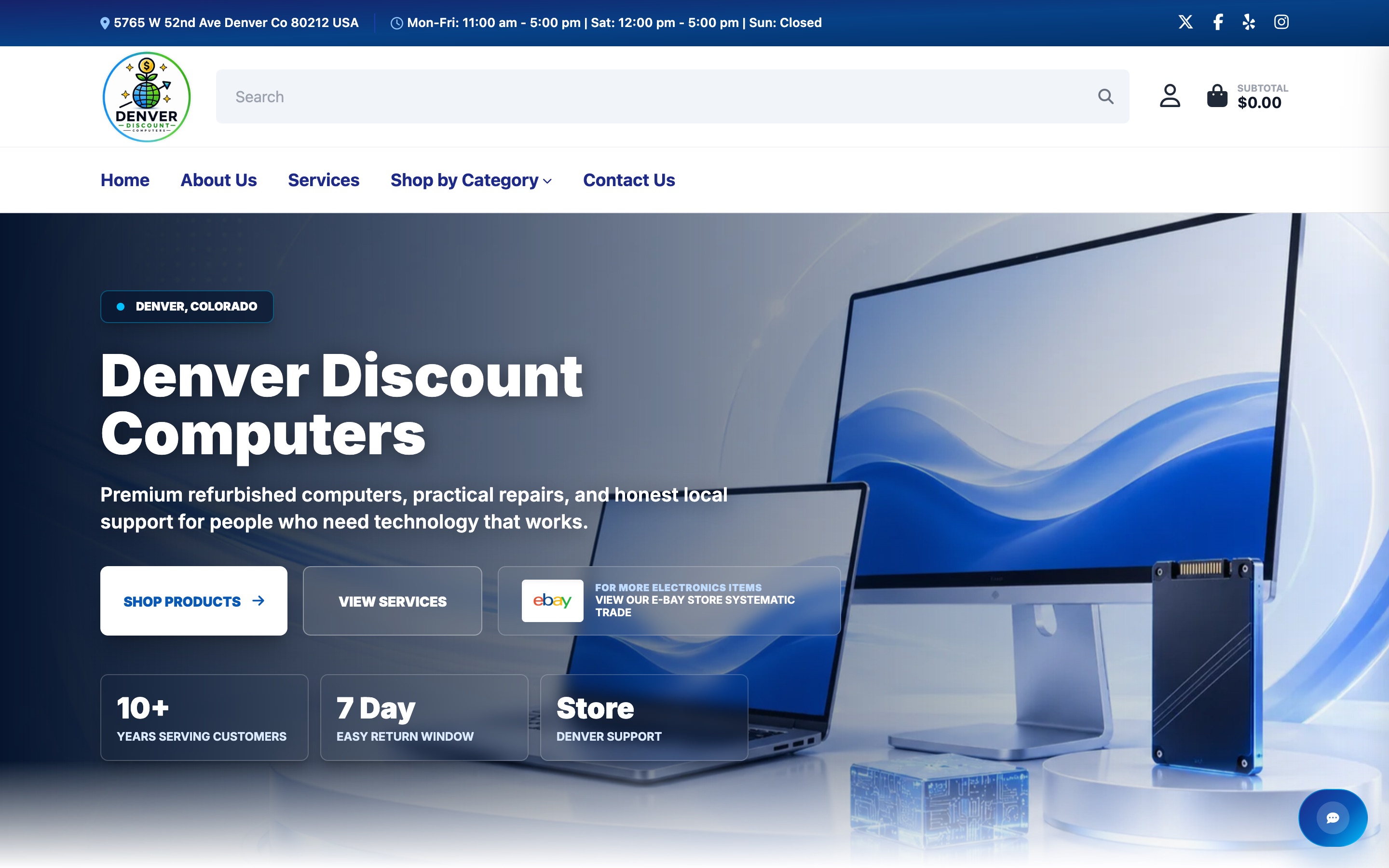
- Role
- Lead Full-Stack Architect, Ops Engineer & Project Manager
- Timeline
- 3 months
- Team
- Remote team
- Focus
- E-commerce · ERP · Multi-channel
01
The problem
Selling one-off refurbished hardware on both an independent storefront and eBay creates costly stock collisions, cancellations, and seller penalties when inventory isn’t synced immediately. Manual warehouse intake—serials, specs, cosmetic grade, cost basis—slowed velocity and introduced error. Off-the-shelf multi-channel ERP SaaS added high monthly seats, per-listing fees, and commissions that eroded margins for an early-stage hardware business.
02
Role & responsibilities
- Architected a unified ERP/admin portal for inventory, specs, cost/expense ledger, and customer CRM
- Built a single-intake listing engine that publishes once to the web store and eBay via REST APIs
- Integrated thermal barcode printers and USB/Bluetooth scanners with unique SKUs and Code-128 labels
- Engineered bi-directional sync with webhooks, row-locking, and instant unlist/end-item on the alternate channel
- Shipped a conversion-focused catalog with local pickup/delivery options and local SEO schema
- Led 0→1 foundation: business formation, vendor sourcing, budget allocation, and technical roadmap
03
Process
Month 1 — Foundation
Scoped the full operating system—storefront, ERP, eBay sync, and POS hardware. Planned backend infrastructure, data models, and channel contracts, then ran early prototypes and spike tests to validate the multi-channel architecture before committing to build.
Month 2 — MVP & systems
Delivered an MVP of the admin ERP and listing pipeline. Fleshed out the backend: inventory, cost ledger, barcode SKUs, and the bi-directional sync engine. Ran internal testing with warehouse workflows so intake, listing, and stock reconciliation held up under real use.
Month 3 — Launch
Final testing across web store and eBay edge cases (concurrent sales, unlist races). Hardened for launch, then kicked off marketing and media—paid local search balanced with marketplace listings—so live inventory could convert from day one.
04
Execution
Over three months, replaced fragmented SaaS with a lean in-house stack: physical intake via scanner/label printer → admin ERP → automated dual listing → real-time sync that unlists the alternate channel the moment an item sells. Month one locked architecture and scope; month two got the MVP and sync engine battle-tested; month three shipped to production with a coordinated marketing push.
05
Impact
$20k
Monthly sales
0
Oversell collisions across channels
25→<5 min
Intake to live listing
$k+/yr
Saved vs. multi-channel SaaS
06
Learnings
"For one-of-a-kind inventory, the product is the sync contract between channels—not the storefront alone. Building the ERP in-house turned recurring SaaS fees into a durable operating advantage, and barcode-first intake made multi-channel availability a warehouse habit instead of a data-entry chore."
Next case study
IT Investment Recoveries →